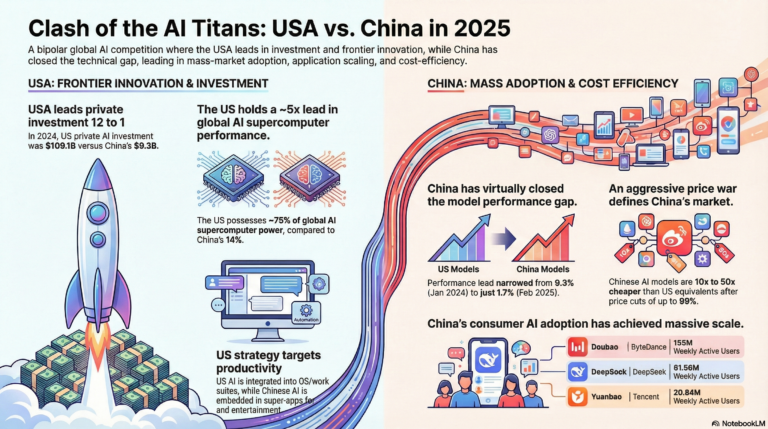
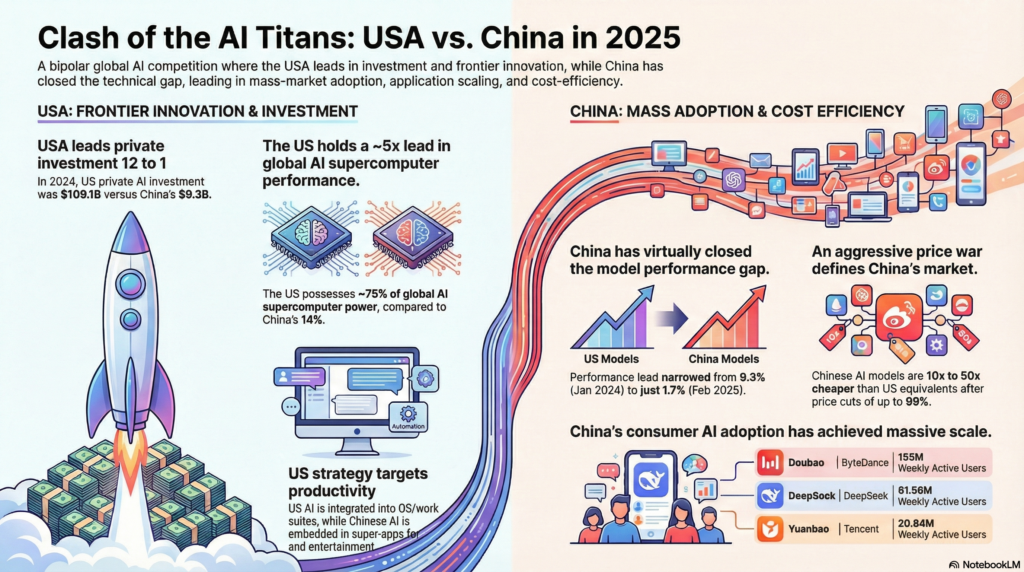
The global landscape of artificial intelligence in late 2025 has shifted from a period of absolute American hegemony to a state of contested parity. While the United States continues to set the “cognitive ceiling” with flagship models, the performance gap between US frontier labs and their Chinese counterparts has remarkably compressed to less than three months.
This blog post explores the three pillars defining this new era: technical convergence, the “commodity” economics of intelligence, and the persistent challenge of cultural localization.
1. The Erosion of the Frontier Lead
The defining technical development of 2025 is the realization of parity in critical cognitive domains. While US models like GPT-5.1 and Gemini 3 Pro maintain a marginal lead in high-stakes reasoning, Chinese models have essentially closed the gap in mathematical proficiency and competitive coding.
- Reasoning Parity: On the “Humanity’s Last Exam” benchmark, Kimi K2 Thinking achieved a score of 44.9%, nearly matching Gemini 3 Pro’s 45.8% and significantly outperforming GPT-5.
- The Coding “Silent” Adoption: Chinese models like DeepSeek-V3.2 now match the performance of Western counterparts in competitive programming, leading to a “silent” adoption in Silicon Valley where US startups use Chinese open-source models to reduce operational costs.
2. The Economics of Intelligence: A Brutal Price War
China has turned AI intelligence into a low-margin commodity through a sustained and “brutal” price war. Major players like ByteDance, Alibaba, and Baidu are aggressively undercutting each other to capture the Model-as-a-Service (MaaS) market.
- The 99% Discount: ByteDance’s Volcano Engine slashed prices for its flagship Doubao Pro model by 99.3%, leading Alibaba to mirror these cuts by up to 97%.
- The Revenue Paradox: While this has accelerated adoption—reaching 536.7 trillion token invocations in early 2025—the total MaaS market value remains a fraction of the multi-billion dollar AI revenues earned by US hyperscalers.
3. The Culture Gap: Localization and “Sociocultural Adequacy”
Despite reaching parity in logic and math, a significant “cultural gap” remains. Chinese-developed models demonstrate a distinct advantage in understanding linguistic nuances, idioms, and specialized knowledge like Traditional Chinese Medicine (TCM).
- The TCM Benchmark: In a study using the National Medical Licensing Exam for TCM, Chinese models like Qwen-max and GLM-4 consistently passed, while all Western models (including GPT-4 and Gemini) failed with an average accuracy of just 35.9%.
- Localization in Gaming: Case studies of Black Myth: Wukong reveal that while LLMs are accurate, they often struggle with sociocultural adequacy. For example, LLMs might translate a mythological term literally as “shrimp soldiers and crab generals,” whereas human translators adapt it to the colloquial “knuckleheads” to preserve the character archetype.
4. Hardware Sovereignty and Transactional Diplomacy
The geopolitical reality of AI in 2025 is governed by “transactional diplomacy”. The US has shifted from strict bans to a “Trump Waiver” policy, allowing the export of high-end Nvidia H200 chips to China subject to a 25% federal fee.
This has enabled Chinese giants to make massive infrastructure bets. ByteDance finalized a $23 billion capital expenditure plan for 2026, earmarking $12 billion for high-end semiconductors to bridge the “compute gap” and power its next-generation multi-modal models.
Conclusion: The Implementation Engine
As we look toward 2026, the AI race has settled into a pattern of specialized strengths. The United States remains the primary source of breakthrough cognitive leaps, but China has become the world’s “implementation engine,” turning those breakthroughs into scalable, consumer-ready products at an order of magnitude lower cost.
Analogy for Understanding the Landscape: The current state of AI competition is like Formula 1 racing: the US is designing the revolutionary new engine architectures (fundamental reasoning and cognitive breakthroughs), while China is the master of the pit crew and aerodynamics (implementation, cost-efficiency, and mass-market deployment). While the US sets the top speed, China is ensuring that the car can run more laps, for more people, at a fraction of the fuel cost.