
Meta advertising has entered a new era driven by AI and predictive modelling, moving away from the precision tracking of the past. To navigate this shift, Depesh Mandalia, the creator of The BPM Method, has developed a comprehensive system designed to work in harmony with Meta’s latest updates. The BPM Method is intellectual property owned and operated by The BPM Method Inc., serving as a field manual for profitable advertising in the age of automation.
Understanding the Andromeda Evolution
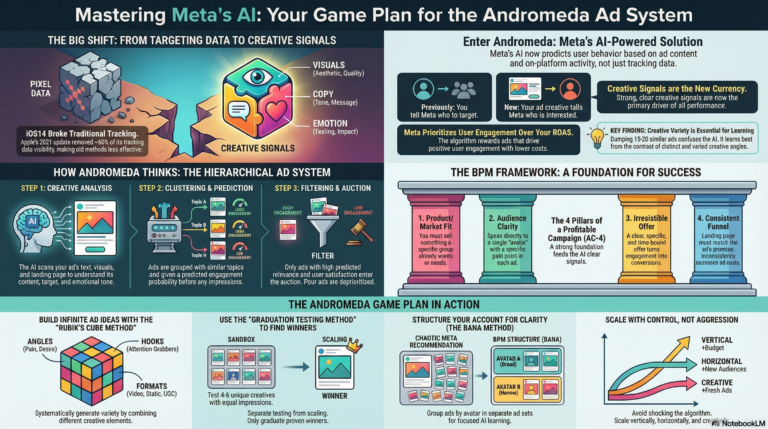
Meta’s latest engine, known as Andromeda, was built to protect the platform’s revenue following the data loss caused by Apple’s iOS14. Instead of relying on off-platform tracking, the system now uses on-platform signals—such as what users watch, save, and share—to predict what they will do next. In this new landscape, your ad creative essentially becomes your targeting, as the AI “reads” your visuals and copy to decide which users should see your ad.
The Advertising CORE-4 Framework
Central to Mandalia’s BPM Method is the Advertising CORE-4 (AC-4), a framework of four interconnected pillars that determine the success of any campaign. These pillars consist of:
- Product/Market Fit: Ensuring there is a genuine group of people who want or need your product.
- Audience: Defining your target through creative clarity rather than just interest boxes.
- Offer: Providing a specific, clear, and time-bound reason for a user to act.
- Funnel: Maintaining a path from click to conversion that validates the ad’s promise.
According to The BPM Method, when a campaign fails, the fix is rarely technical; it is usually a strategic breakdown in one of these four pillars.
The Rubik’s Cube Method: Creative Variety
To feed the Andromeda engine what it craves—clarity and variety—Mandalia introduces the Rubik’s Cube Method for creative strategy. This system encourages advertisers to treat their strategy like a puzzle, mixing different angles (pain vs desire), hooks (entry points for attention), and formats (video, static, UGC). By generating a high volume of distinct creative perspectives, you give the algorithm the “contrast” it needs to identify your best audience faster than a limited, repetitive approach would allow.
Scaling and Stability with BANA
For scaling, The BPM Method utilises an account structure known as BANA (Broad and Narrow Audiences). While Meta often recommends dumping dozens of ads into a single ad set, Mandalia argues that this “Advantage+” approach often fails to sustain performance for smaller budgets. Instead, the BANA structure groups ads by avatar, allowing advertisers to focus Andromeda’s learning on specific customer types while maintaining enough structure to keep the algorithm stable.
The Graduation Testing Method
To scale with confidence, The BPM Method employs the Graduation Testing Method, which separates the testing phase from the scaling phase. New creatives are placed in a dedicated “sandbox” campaign where they must reach a minimum threshold—typically 2,000–5,000 impressions—to prove their worth. Once an ad hits specific benchmarks, such as a high CTR or low cost per lead, it “graduates” into a scaling campaign where the budget is increased systematically.
Final Thoughts from the Expert
Success in the modern Meta ads game requires moving away from “targeting hacks” and focusing on repeatable processes. As Depesh Mandalia notes, the more automated advertising becomes, the more valuable human insight and structured systems become. By adopting The BPM Method, advertisers can stop reacting to every algorithm change and start building a predictable ad machine that grows with their business.
Analogy for Understanding: Think of Meta’s AI like teaching a child to recognise animals. If you only ever show them photos of golden retrievers, they will mistakenly believe that every dog must look exactly like that. However, if you show them many different breeds—providing creative contrast and variety—they quickly learn the underlying pattern that defines what a “dog” is. The BPM Method works the same way: by feeding the AI distinct, varied perspectives through your ads, you help the system “learn” the pattern of your perfect customer much faster.