The contemporary economic landscape of Malaysia is undergoing a profound structural shift as artificial intelligence (AI) transitions from a speculative technological frontier to a foundational driver of industrial performance. For Small and Medium Enterprises (SMEs), which constitute 97.4% of all business establishments, AI integration is no longer a peripheral interest but a core component of sustainable competitiveness. With the nation progressing toward its goal of a digital sector contributing 25.5% to the GDP by 2025, the successful onboarding of nearly one million SMEs into the AI ecosystem has become a primary policy objective.
The Adoption Paradox: Velocity vs Maturity
Malaysia is witnessing an aggressive acceleration in AI integration, with the total number of AI-enabled businesses reaching 2.4 million in 2025. This represents a staggering adoption rate of more than one business per minute during the past year. However, a deeper analysis reveals a “two-tier AI economy” where volume does not equate to depth.
While adoption numbers are high, 73% of Malaysian businesses remain focused on basic applications—such as scheduling assistants or off-the-shelf data tools—missing out on the deeper strategic advantages the technology offers. In contrast, startups are proving to be the true leaders in innovation; 31% of AI-adopting startups are building entirely new AI-driven products, compared to just 15% of large enterprises.
The Compelling Business Case for AI
The motivation for this technological shift is clearly financial. Businesses that have successfully integrated AI report significant returns, including:
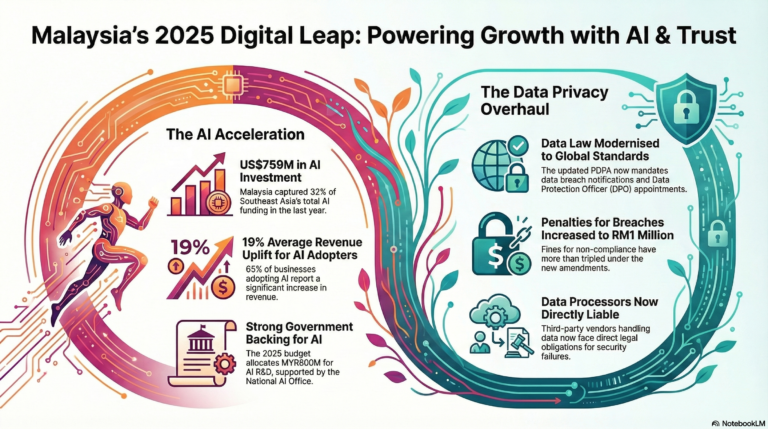
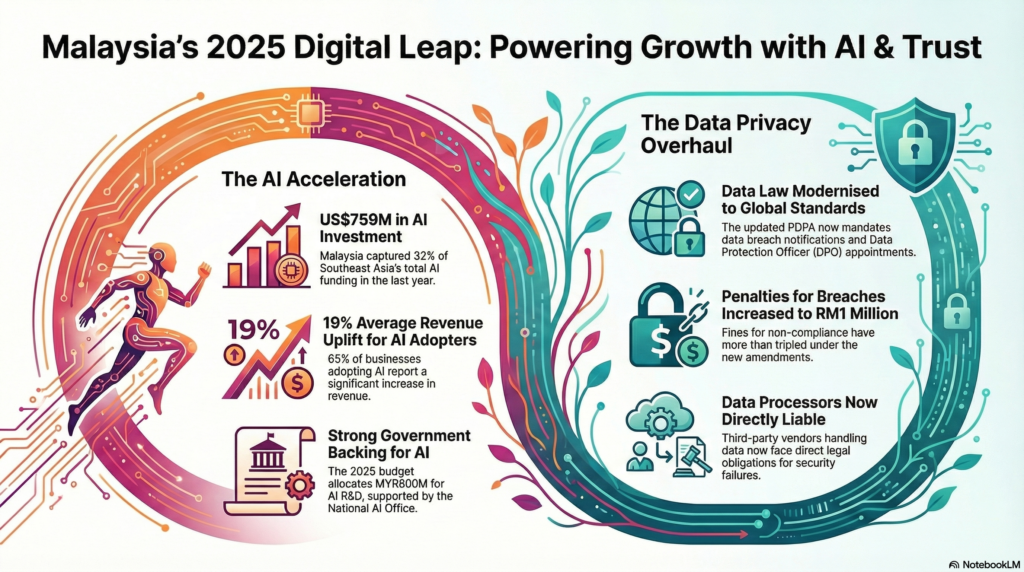
- Revenue Growth: 65% of adopting businesses report an average revenue increase of 19%.
- Productivity Gains: 72% of firms have seen significant improvements in their operational efficiency.
- Cost Reductions: Businesses expect an average of 15% in cost savings through the automation of routine tasks.
By 2030, AI is projected to generate approximately USD 115 billion in productive capacity for Malaysia.
Navigating the Barriers: Talent and Cost
Despite the clear ROI, several bottlenecks restrict deeper integration. The skills gap remains the single largest barrier, cited by 52% of Malaysian businesses. While 68% of leaders recognise digital skills as crucial, only 29% feel their current workforce is adequately prepared for an AI-driven future. This talent deficit has led to a bidding war, with firms willing to pay a 34% salary premium for candidates with strong AI and machine learning expertise.
Additionally, 39% of businesses cite upfront costs as a major hurdle, highlighting a need for greater awareness of available financial support.
Strategic Frameworks for Success
To move beyond basic efficiency, SMEs should adopt established theoretical models such as the Technology-Organization-Environment (TOE) framework and the Technology Acceptance Model (TAM). These models suggest that successful adoption depends on eight key factors, including top management support, employee adaptability, and perceived usefulness.
Experts suggest a “start simple” approach: momentum matters more than mastery. Rather than waiting to become an expert, business owners should begin with a single file and a single question—such as uploading a financial report and asking AI to identify trends or risks.
Leveraging the Malaysian Ecosystem
Malaysian SMEs have access to unique local resources designed to bridge the gap between traditional processes and Industry 4.0:
- The MADANI Grant 2025: This government initiative provides a 50% matching grant of up to RM 5,000 to help SMEs adopt digital tools, including AI chatbots and CRM systems.
- ILMU (Intelek Luhur Malaysia Untukmu): Malaysia’s first homegrown multimodal large language model outperformed global leaders like GPT-4o in the Malay language context, offering SMEs superior cultural and linguistic accuracy.
- MDEC AI Skills Training: Fully HRD Corp-claimable programmes are now available to upskill staff in AI-driven sales, customer engagement, and office management.
Conclusion: From Optimization to Transformation
The path to 2030 requires a shift in mindset from “AI optimization” (doing existing tasks faster) to “AI transformation” (creating entirely new business models). For a Malaysian SME to thrive, it must prioritise data readiness, leverage locally grounded models like ILMU, and proactively utilise national grants to close the talent gap.
Think of AI adoption not as a one-time project, but as a digital bridge. It is a structure designed to connect your various business data points so they can finally “speak” to one another, providing a complete picture of your future success.